
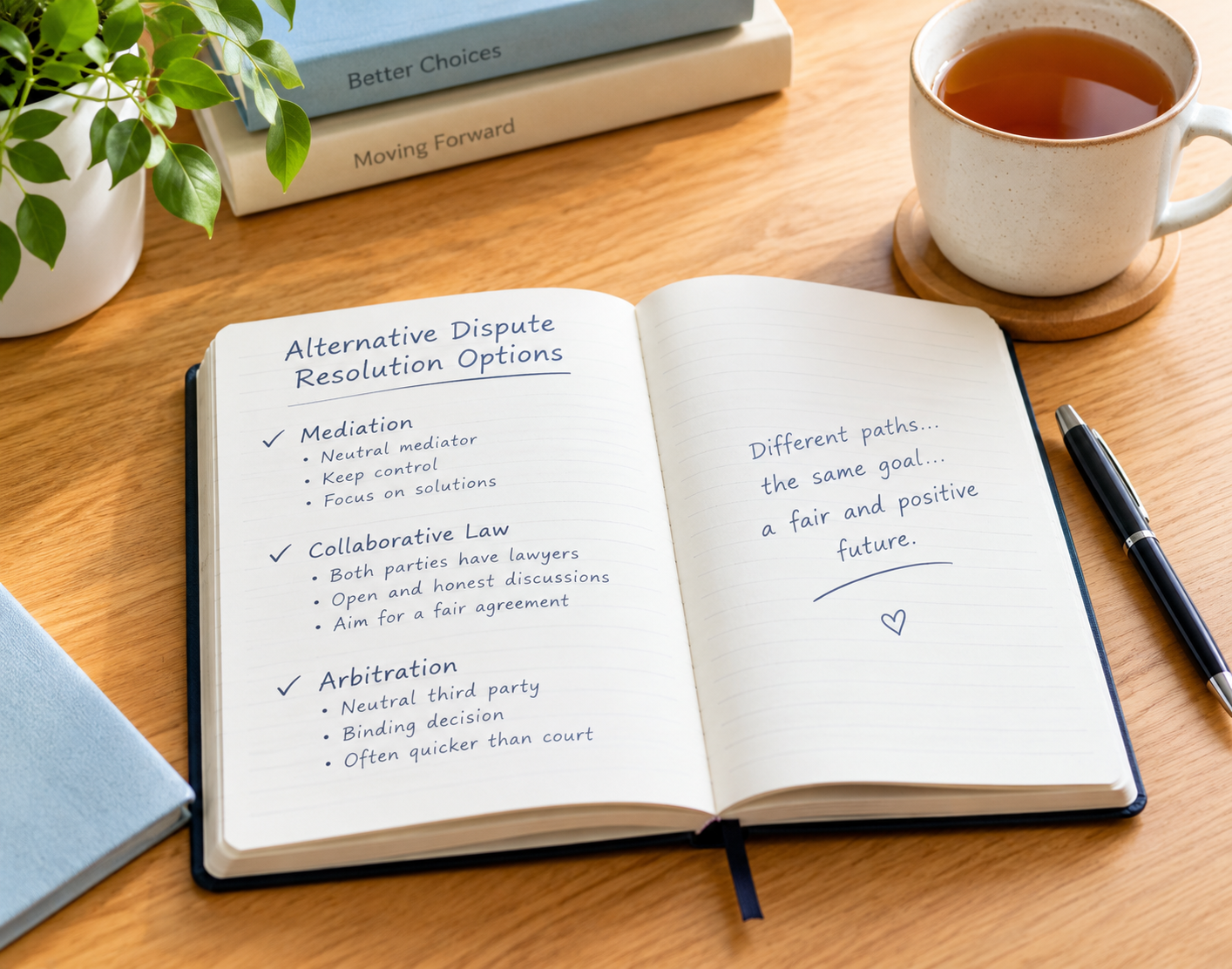
Divorce does not have to mean a courtroom. Many people ask, “Are there any alternative non-court dispute resolution methods I can use when going through a divorce?” The answer is yes. In fact, several alternatives to court for divorce disputes exist, and each one can help you reach agreement faster and with less stress. At Family Mediation Services, our accredited mediators help families settle without court, so we see first-hand how a calmer process helps everyone involved. Therefore, we have summarised the main options below.
Why consider non-court dispute resolution for divorce?
Court can feel slow, costly and adversarial. Moreover, a judge decides the outcome, so you lose control over the result. Non-court dispute resolution for divorce gives you more say. In addition, it often keeps communication open between you and your ex-partner. That matters most when children are involved, because parents who cooperate usually create a more stable home for them.
1. Mediation
Mediation is the most common and affordable option. An accredited mediator stays neutral and helps you and your ex-partner talk through money, property and child arrangements. The mediator does not take sides or make decisions for you. Instead, you both decide what works.
Family mediation starts from as little as £85 for the MIAM (Mediation Information and Assessment Meeting). Alternatively, you can apply for legal aid to cover the cost of your mediation. At Family Mediation Services, we also offer legal aid and the government voucher. Divorce mediation and alternative dispute resolution often go hand in hand, and mediation remains the most popular route for good reason. You can expect a top tier family mediation services with an accredited family mediator qualified to the highest standard.
2. Conciliation
Conciliation brings you and your lawyers together for a round-table discussion. As a result, you reach a lawyer-informed agreement without weeks of back-and-forth letters. However, one important rule applies. If you do not reach agreement, your lawyers cannot represent you in any later court proceedings.
This rule removes the conflict of interest that can arise when the same lawyers represent you throughout. Consequently, everyone at the table has a strong reason to find a solution.
3. Arbitration
Arbitration works like a private, quasi-judicial process. You present your case through your legal representative. Then an arbitrator, often someone you both agree on, makes a decision. Importantly, you agree in advance that the decision will be binding. Therefore, arbitration gives you certainty without a public court hearing.
4. Collaboration
Collaborative law is another route. Each of you hires a specially trained lawyer, and all four of you meet to negotiate. You commit to settling without court. Similarly, the lawyers step aside if talks break down. As a result, everyone stays focused on finding an agreement.
Why does mediation stand out?
Mediation offers a voucher that helps you cover costs. In contrast, none of the other methods offers legal aid, a reduction or lower fees from the outset. For this reason, many families see mediation as the most powerful and popular of the alternatives to court for divorce disputes. Furthermore, it moves quickly. On average, our cases conclude in three sessions within two to eight weeks, and mediation can sit alongside legal advice so you stay informed at every step.
Choose an accredited mediator for expert guidance
Whichever method you choose, expert guidance matters. At Family Mediation Services, we handle all case types, including child arrangements, property and finance, and inheritance. Meanwhile, you can focus on reaching an agreement that works for your whole family.
Ready to take the next step?
Contact Family Mediation Services today to start mediating. Call us on 0300 365 2700 or email at admin@familymediationservices.co.uk, and our friendly team will explain how we can help.
Frequently Asked Questions
The main options are mediation, conciliation, arbitration and collaborative law. Each lets you settle without a judge deciding for you. Mediation is the most common and affordable choice.
Family mediation starts from as little as £85 for the MIAM. In addition, you can apply for legal aid, and a voucher can help you cover mediation costs.
Yes. You agree in advance that the arbitrator’s decision will be binding. Therefore, choose arbitration only when you feel ready to accept the outcome.
Your lawyers cannot represent you in any later court proceedings. As a result, you would need to instruct new lawyers if you go to court.
Mediation suits most families because it costs less and keeps you in control. However, every case differs, so speak to a family solicitor for advice on your situation.
On average, cases conclude in three sessions within two to eight weeks. However, the time you need depends on how many issues you discuss.
Yes. Mediation helps parents agree child arrangements together. At Family Mediation Services, an accredited mediator keeps the focus on your children’s needs.
Key Takeaways
- Divorce does not have to involve court; several alternative non-court dispute resolution methods exist.
- Options include mediation, conciliation, arbitration, and collaboration, each providing a way to settle disputes without a judge.
- Mediation is the most common and affordable methods, often starting from £85 and offering legal aid options.
- Using conciliation involves lawyers in discussions, but they cannot represent you later if the process fails.
- Choosing an accredited mediator ensures expert guidance and helps reach agreements that benefit the whole family.